

Data 360 and AI
Data 360 and AI for Success
Data 360 is Salesforce’s unified data platform that consolidates enterprise data from multiple sources into a single, trusted foundation, enabling AI-powered insights and personalized customer engagement at scale.
Turn your data into measurable business value with Data 360 and AI. Data 360 unifies enterprise data across systems within Salesforce, eliminating silos and creating a real-time, 360-degree view of your customers. With a consistent and reliable data layer, organizations can make faster, more informed decisions that directly impact growth and performance.
When combined with AI capabilities powered by Agentforce and secured by the Einstein Trust Layer, this unified data foundation enables intelligent automation, predictive insights, and highly personalized customer engagement at scale.
Key Benefits of Data 360 and AI
- Increased revenue through smarter targeting and personalized experiences.
- Reduced operational costs through AI-driven automation.
- Improved productivity across sales, service, and marketing teams.
- Faster time-to-value from data investments.
- Stronger customer retention and lifetime value.
What is Data 360?
Data 360 brings enterprise and customer data together into one unified platform across Salesforce. Once unified, this data can be segmented and activated for marketing, sales, service, and commerce, enabling personalized engagement, intelligent automation, and measurable business impact.
How Data 360 Works?
From Fragmented Data to Unified Intelligence

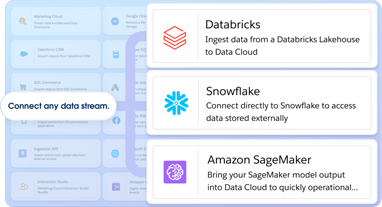
Data Ingestion
Connect CRM, ERP, billing systems, marketing platforms, web data, and operational sources.
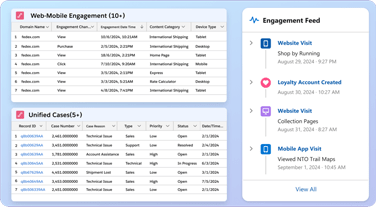
Identity Resolution
Unify duplicate and inconsistent records into a single customer profile using metadata, matching rules, and harmonization.
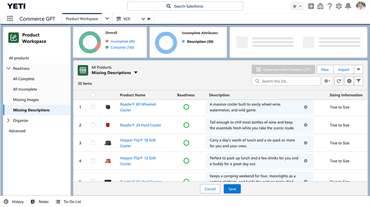
Real-Time Profiles
Create continuously updated profiles that are accessible across Salesforce teams and applications.
Data Activation
Trigger personalized engagement, automation, forecasting, and AI driven insights in real time.

AI Powered by Agentforce
Boost efficiency and personalization with AI embedded throughout Salesforce workflows. Agentforce enables teams to automate tasks, generate actionable insights, and deliver intelligent interactions within the CRM, helping employees work faster and customers engage more meaningfully.
Secured by the Einstein Trust Layer, AI uses trusted customer data to deliver reliable recommendations, automate actions, and support smarter decisions with confidence.
Understanding Data 360 and Agentforce
| Component | Function | Role |
|---|---|---|
| Data 360 | Unified data platform | Consolidates enterprise data into a single foundation for AI and analytics |
| Agentforce | AI assistant | Automates workflows, generates insights, and enables conversational AI within CRM |
In case of larger projects, we suggest multiple scrum teams to keep things manageable.
Data 360 and Agentforce
Data 360 centralizes and unifies enterprise and customer data within Salesforce, creating a trusted foundation for segmentation and activation. Agentforce builds on this data to automate workflows, generate recommendations, and power AI-driven engagement across the organization.
Agentforce Capabilities by Function

Agentforce for Sales
Agentforce enhances the sales workflow by automating outreach, summarizing conversations, analyzing pipeline performance, and recommending nextbest actions—helping sellers focus on highvalue engagement and revenue growth.
Agentforce for Service
Agentforce improves service operations with AIdriven assistance that surfaces relevant knowledge, recommends nextbest actions, and automates routine tasks, resulting in faster response times, higher productivity, and improved satisfaction.
Agentforce for Marketing
Agentforce activates unified customer data to personalize journeys, optimize segmentation, and drive realtime engagement strategies.

Agentforce for Commerce
Agentforce improves commerce experiences with intelligent product recommendations, automated content creation, and streamlined purchasing, driving higher conversion and operational efficiency.

How Nespon Delivers Data 360 and AI Success
Nespon provides comprehensive consulting services for Data 360 and AI implementations:
- End-to-End Implementation: From strategy and architecture to deployment and optimization
- Industry-Specific Solutions: Tailored use cases for healthcare, financial services, retail, and manufacturing
- Data Integration Expertise: Connecting disparate systems and ensuring data quality across your enterprise
- AI Enablement: Configuring Agentforce and Einstein capabilities to match your business workflows
- Ongoing Optimization: Continuous support to maximize ROI from your Salesforce investments
From providing support to offering expert guidance and resources, we ensure you maximize Salesforce’s value in the AI era. Count on us for tailored assistance and unique solutions, supporting your business growth through AI integration.
Frequently Asked Questions
Evaluate vendors based on their Salesforce Data Cloud expertise, integration experience, industry knowledge, and ability to deliver measurable business outcomes. Look for experience with identity resolution, data governance, AI enablement, and enterprise integrations. Ask for relevant case studies, Salesforce certifications, and details about their post-implementation support.
Start by identifying your data sources and assessing data quality. Remove duplicates, standardize formats, fill missing values, and define governance policies. Clean, well-organized data helps Data Cloud create accurate unified customer profiles and improves AI, analytics, and personalization.
Salesforce Data Cloud continuously updates unified customer profiles with data from connected systems. This gives AI agents access to current customer context, enabling more accurate responses, better recommendations, and smarter automation based on real-time information.
Data Cloud updates customer profiles as new interactions occur, allowing businesses to personalize marketing, sales, and service experiences in near real time. This helps deliver relevant recommendations, targeted campaigns, and consistent customer journeys across channels.
Data Cloud connects data from Salesforce applications and external systems, then uses identity resolution to match records into unified customer profiles. This creates a single, trusted view of each customer across the business.
Implementation time depends on project complexity. A focused deployment can often be completed in 8 to 12 weeks, while larger enterprise implementations with multiple integrations and business units typically take several months.
The effort depends on your existing data quality and systems. Most projects require data mapping, cleansing, and governance, while organizations with complex or fragmented data may need additional engineering before implementation.
Costs vary based on licensing, implementation scope, integrations, data volume, and business requirements. Most organizations work with a Salesforce implementation partner to assess requirements and estimate the total investment.
Salesforce Data Cloud connects with Sales Cloud, Service Cloud, Marketing Cloud, Commerce Cloud, external databases, cloud storage, data warehouses, APIs, ERP systems, websites, mobile apps, and many third-party applications through connectors and integrations.
Industries with large volumes of customer data benefit the most, including telecommunications, financial services, retail, healthcare, insurance, manufacturing, and the public sector. These organizations use Data Cloud to improve personalization, analytics, and AI-driven customer experiences.
After deployment, organizations should monitor data quality, maintain integrations, refine identity resolution, update governance policies, onboard new data sources, and optimize use cases. Many businesses also use managed services for ongoing support.
A successful Data Cloud project typically involves Salesforce architects, data engineers, integration specialists, business analysts, project managers, and governance experts working together to ensure a secure and scalable implementation.
Common use cases include Customer 360, real-time personalization, customer segmentation, AI-powered recommendations, marketing optimization, churn prediction, customer journey orchestration, and analytics based on unified customer data.
A typical implementation includes discovery, architecture design, data integration, identity resolution, governance, testing, deployment, user enablement, and ongoing optimization. Many organizations begin with a high-value use case before expanding further.
Traditional data warehouses focus on storing data for reporting, while Salesforce Data Cloud unifies customer data in near real time and activates it across Salesforce applications, automation, and AI. It complements rather than replaces existing data warehouses.
Certified Salesforce consulting partners with Data Cloud expertise specialize in implementation, integrations, governance, and optimization. Nespon Solutions, a Salesforce Summit Partner, helps enterprises implement and optimize Salesforce Data Cloud for AI and customer data initiatives.
Salesforce implementation partners with Data Cloud expertise can integrate it with Sales Cloud, Service Cloud, Marketing Cloud, Agentforce, MuleSoft, and other enterprise systems while ensuring secure, scalable, and well-governed deployments.
Enterprise Data Cloud implementations are typically delivered by certified Salesforce consulting partners experienced in architecture, integrations, governance, and AI. Partners such as Nespon Solutions help organizations plan, deploy, and optimize Data Cloud for enterprise-scale use.
Let’s Take the First Step Together
Nespon’s industry expertise and unique delivery model offer cost-effective solutions for industry-specific needs. Our Salesforce specialization drives accelerated results in platform implementation, improvement, or digital transformation.